
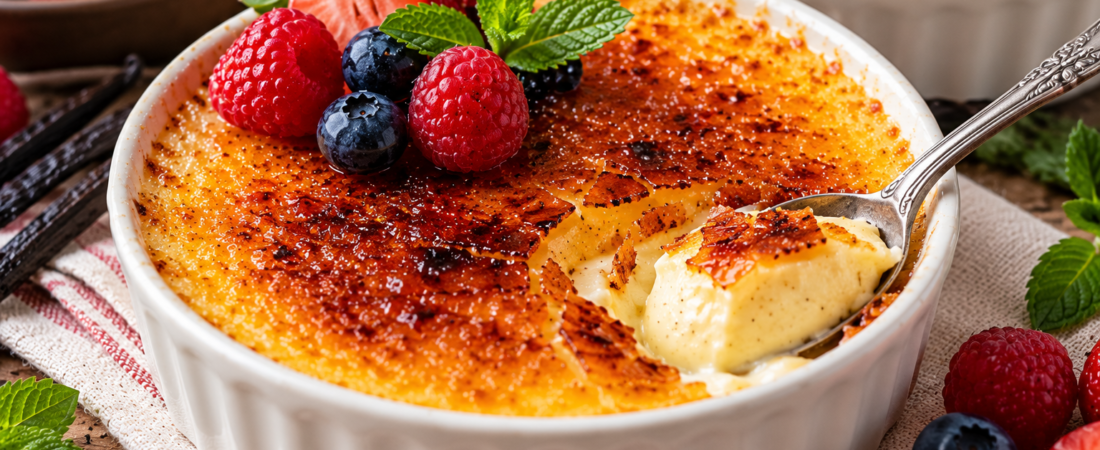
This classic Crème Brûlée has a silky vanilla custard beneath a thin, crisp layer of caramelised sugar. It is an elegant dessert that can be prepared ahead and finished just before serving.
Thank you for reading this post, don’t forget to subscribe!Ingredients
- 2 cups (480 ml) heavy cream
- 1 vanilla bean, split lengthwise, or 2 tsp vanilla extract
- 5 large egg yolks
- 1/2 cup (100 g) granulated sugar
- 1/4 tsp fine salt
- 1/4 cup (50 g) superfine or granulated sugar, for caramelising
Instructions
- Preheat the oven to 325°F (165°C). Place four 6-ounce (180 ml) ramekins in a deep baking dish.
- Heat the cream with the vanilla bean in a saucepan over medium heat until steaming and just beginning to simmer around the edges. Do not boil. Remove from the heat and let it infuse for 5–10 minutes. If using vanilla extract, add it later with the salt.
- In a bowl, whisk the egg yolks, sugar and salt until smooth and slightly lighter in colour.
- Slowly pour the warm cream into the yolk mixture while whisking constantly. Strain the custard through a fine-mesh sieve into a jug, then stir in the vanilla extract if using.
- Divide the custard evenly among the ramekins. Pour hot water into the baking dish until it reaches about halfway up the sides of the ramekins.
- Bake for 30–40 minutes, until the edges are set but the centres still have a gentle wobble. The custard should be cooked through but not browned.
- Carefully remove the ramekins from the water bath and cool them at room temperature for about 30 minutes. Cover and refrigerate for at least 4 hours, preferably overnight.
- Just before serving, pat the tops dry if any moisture has formed. Sprinkle each ramekin with a thin, even layer of the topping sugar.
- Caramelise the sugar with a kitchen torch, moving the flame continuously, until deeply golden and bubbling. Alternatively, place the ramekins under a very hot grill for 1–2 minutes, watching closely.
- Let the caramel harden for 1–2 minutes, then serve immediately.
Cooking Tips
- The original recipe used too little cream and too few egg yolks for a stable custard. The corrected ratio produces a smooth, rich texture.
- Do not boil the cream or the custard. Gentle heat helps prevent scrambled eggs and curdling.
- Strain the custard before baking to remove any cooked egg particles and vanilla bean pieces.
- Use a thin, even layer of sugar for a crisp caramel shell that is easy to crack with a spoon.
- Caramelise the sugar only after the custards are fully chilled. The torch can warm the surface, but the centre should remain cold.
Storage
Keep the baked custards covered and refrigerated for up to 3 days. Add and caramelise the sugar topping just before serving, because it softens during refrigeration.
Recipe Details
Prep: 20 minutes · Chill: 4 hours · Cook: 35 minutes · Total: About 5 hours · Serves: 4
Frequently Asked Questions
How do I know when Crème Brûlée is done?
The edges should look set while the centre gently wobbles when the dish is nudged. It will firm further as it cools.
Can I make Crème Brûlée without a torch?
Yes. Use the oven grill or broiler, keeping the ramekins close to the heat and watching continuously because the sugar can burn quickly.
Why is my custard grainy?
The custard may have been overheated or baked too long. Use a water bath, avoid boiling the cream and remove the ramekins when the centre still has a slight wobble.
The Story Behind This Recipe
Crème brûlée is a classic custard dessert associated with French cuisine, although similar burnt-sugar custards appear in several European traditions. Its signature contrast is a cold, silky custard beneath a warm, brittle caramel crust.
The exact origin is debated: related desserts include Spain’s crema catalana and England’s Trinity cream, so no single country can claim an uncontested beginning. The name and modern restaurant presentation became strongly linked with French culinary tradition, while the caramelised surface reflects an older European technique of finishing custards with sugar and heat. That shared history is why crème brûlée is best understood as part of a wider family of baked custards rather than the invention of one confirmed individual.